
AI Wearable Engineering: 8 Decisions to Make Before Building a Production-Ready Device
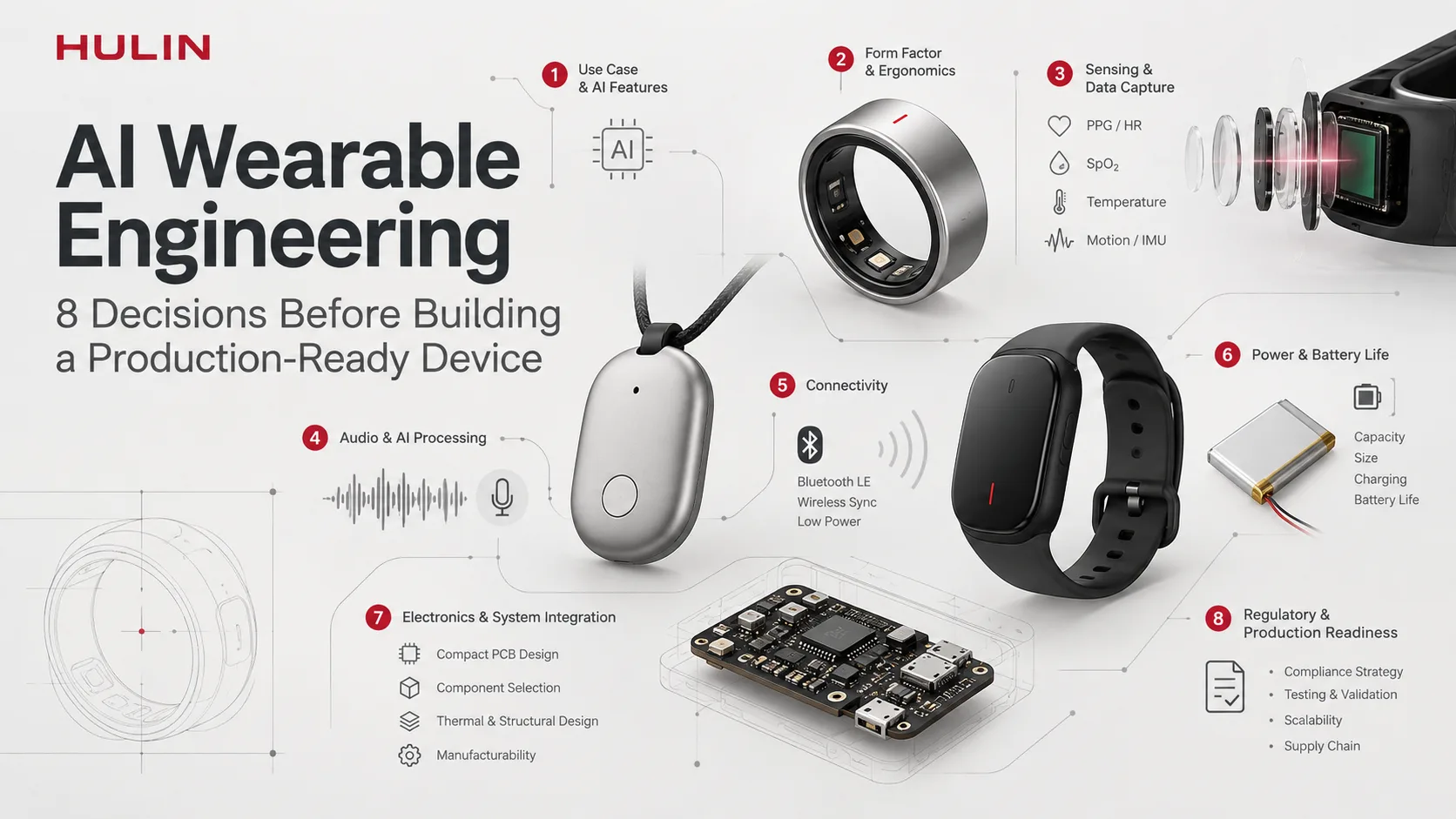
Two products can start with similar silicon, sensors and wireless technology and still end up with very different battery life, data quality, reliability and production cost. The difference often begins before schematic design.
Wearable products are unforgiving because almost every decision competes for the same limited space, power and data budget. A ring cannot absorb a late battery increase without changing fit. A recording pendant may capture clean audio but still fail if storage and synchronization were treated as afterthoughts. A health wearable can collect sensor samples all day and still produce an incomplete timeline if contact, timestamps or reconnect behavior are unstable.
That is why AI wearable engineering starts earlier than component selection. Before optimizing the SoC, microphone, sensor or model, the team needs to decide what the product must do during a normal day, what it must do when the phone is absent, and which failures the user should never have to think about.
The eight decisions below are not a universal process template. They are a practical way to expose the constraints that usually become expensive when they are left until after the board, enclosure or software interfaces are already fixed.
01 Define product behavior before choosing the architecture
A product requirement such as "record meetings," "track sleep," or "show health trends" is not yet an engineering definition. The architecture starts to become useful only when the behavior is described over time.
For a recording wearable, that means deciding what starts and stops a session, whether the device can record without a phone, what happens when local storage is nearly full, and whether an interrupted transfer resumes from the last confirmed block or starts again. For a health wearable, it means defining which signals are continuous, which are periodic, what the product does when skin contact is poor, and how long it must preserve data before the phone returns.
These decisions determine far more than firmware logic. They affect battery sizing, flash capacity, radio scheduling, indicator behavior, app states and cloud responsibilities. If the product behavior is vague, every subsystem makes its own assumptions. Those assumptions eventually meet at integration, when they are most expensive to change.
A useful early deliverable is therefore not a component list. It is a state-and-data description: what the device is doing, what data it creates, where that data goes, what the user sees, and what happens when one part of the chain is unavailable.
02 Let the form factor set the physical boundary
A ring, wristband, watch, pendant and clip may share many electronic functions, but they do not share the same physical problem. The enclosure defines how much room is available for the PCB and battery, where the antenna can live, how the microphone or optical path reaches the outside world, how the product charges, and how it seals against daily wear.
In a ring, mechanical thickness and inner geometry compete directly with battery volume, sensor contact and antenna clearance. In a wrist product, strap behavior and back-cover geometry affect skin contact and movement. A pendant may have more internal volume, but microphone direction, clothing contact and body placement become part of the acoustic problem.
This is why industrial design cannot be treated as a skin applied after electronics are complete. The useful question is not whether a reference appearance can be reproduced. It is which parts of the appearance are fixed, which dimensions can move, and what engineering evidence is needed before those constraints are frozen.
The earlier that mechanical, RF, sensing, acoustic and charging constraints are viewed together, the fewer late changes are pushed from one discipline into another.
03 Build the power budget before promising battery life
Battery life sounds like a battery specification, but it is really a whole-system average-current problem.
Take a simplified 100 mAh battery. Seven days of operation corresponds to about 595 µA of theoretical whole-device average current. Fourteen days reduces that budget to about 298 µA. Those figures are only capacity divided by time: they exclude conversion losses, usable-capacity limits, battery aging, temperature effects and peak-current constraints. Even so, they make one point clear. A subsystem that averages only a few hundred microamps can consume most of the available budget in a small wearable.
The engineering discussion therefore has to move from "this SoC is low power" to a schedule of activity: how long the sensor is awake, how often memory is written, how often the radio connects, how much audio processing runs locally, how long LEDs or haptics are active, and what the device does between useful events.
This is also why battery-life targets should be reviewed together with form factor and user behavior. Increasing battery capacity may enlarge the enclosure or reduce comfort. Reducing sampling may save energy but weaken the information the product is trying to collect. Pushing more work to the phone or cloud may save local compute while increasing radio activity. There is rarely a free improvement; there is a budget that has to be spent deliberately.
04 Decide what data is created before deciding where AI should run
AI placement is often discussed as an abstract choice between edge and cloud. In a wearable, the better starting point is simpler: how much data is the device creating, and what has to happen to that data before it becomes useful?
Uncompressed 16 kHz, 16-bit mono PCM audio is 256 kbps, or about 32 kB/s. That is roughly 115.2 MB per hour, and 460.8 MB for four hours of recording before file headers, redundancy or other overhead. A product that sounds small in physical terms can therefore create hundreds of megabytes of raw audio in a single day.
Sensor streams accumulate more quietly. As a concrete reference, Bosch Sensortec's BMI270 exposes 16-bit three-axis accelerometer and 16-bit three-axis gyroscope data and supports output rates well above 100 Hz. If six 16-bit axes are logged at 100 Hz, the raw payload alone is about 1.2 kB/s, 4.32 MB per hour, or 103.7 MB per day before timestamps, packet framing and metadata.[1]
Those numbers do not mean every product should store raw data. They explain why data architecture needs to be explicit. A device may reduce data locally through VAD, feature extraction, event detection or compression. It may keep recent data in flash and synchronize later. It may send selected observations to the phone while leaving transcription, summarization or larger-model inference to cloud services.
Running more AI on the device is not automatically more advanced. The useful boundary depends on latency, power, memory, privacy, connectivity and how much the local algorithm can reduce downstream data. The right question is not "Can this model run on the MCU?" It is "What product problem is solved by running it there, and what does that choice cost elsewhere?"
Three numbers that change architecture decisions
- 100 mAh battery / 7 days: ~595 µA theoretical whole-device average. Every always-on subsystem must fit inside the same budget.
- 16 kHz / 16-bit / mono PCM: 256 kbps; ~115.2 MB/hour. Audio quickly becomes a storage, transfer and synchronization problem.
- 6-axis IMU, 16-bit axes, 100 Hz: ~1.2 kB/s; ~103.7 MB/day raw payload. A low sample rate can still create meaningful data volume over 24 hours.
All figures above are simplified engineering calculations from the stated assumptions, not measured Hulin product performance.
05 Treat sensor and microphone specifications as inputs, not outcomes
A component specification describes what a part can do under defined conditions. The product is judged by what remains usable after mechanics, motion, noise, placement, firmware and algorithms have all had their effect.
For health wearables, sensor choice is only one part of signal quality. Skin contact, optical openings, pressure, movement, ambient light, sampling strategy and mechanical tolerances change the information that reaches the algorithm. For recording wearables, microphone sensitivity says little about what happens when the acoustic port is turned away from the speaker, covered by a hand, rubbed against clothing or surrounded by competing voices.
This distinction matters because optimization can move a metric in the wrong direction. Stronger denoising can make audio sound cleaner while removing speech cues that recognition needs. Higher sensor sampling can create more data without improving a poorly coupled optical or mechanical path. A more powerful processor can shorten compute time while increasing peak-current and thermal demands.
The engineering target should therefore be defined at the user-visible output: a usable transcript, a stable trend, a reliable event, a synchronization result that survives interruption. Component specifications help establish the boundary, but they do not replace product-level validation.
06 Design connectivity and storage for failure, not only for the normal path
Wearables spend much of their life outside the clean conditions of a development bench. The phone moves out of range, BLE disconnects, the app is killed, storage fills, a battery falls below the operating threshold, or an OTA is interrupted.
Bluetooth LE itself is a scheduled radio system. In a connection, timing parameters such as the connection interval govern how often the radio can service that link; the radio is not a permanent transparent pipe.[2] That matters because synchronization strategy, latency and radio energy are tied to how data is grouped and moved, not just to the nominal PHY rate.
A robust product therefore needs explicit policies for capture, buffer, store, retry, synchronize, confirm and delete. If a recording is transferred in segments, which side owns the truth about the last confirmed segment? If sensor history is synchronized after a day offline, how are timestamps reconciled? If the app deletes a session before the device receives confirmation, can the data be recovered?
These are not edge cases that can be assigned to "later firmware." They define whether the product loses user data. The earlier the failure behavior is specified, the easier it is to size storage, define protocol states and test recovery instead of discovering it through customer complaints.
07 Give firmware, app, cloud and AI one shared product contract
A wearable is often developed by several teams, sometimes in different companies. That can work well, but only when the interfaces are more precise than a feature list.
The device and app need a shared understanding of state: idle, recording, sampling, synchronizing, charging, updating, error. They need rules for session identifiers, timestamps, configuration versions, retries, file segmentation, deletion and OTA. The backend needs to know which data is authoritative, which fields may change across firmware versions, and what happens when a client is older than the device.
Consider a recording session started on the device while the phone is disconnected. The device may create the file, assign a session ID and keep local time. When the phone returns, the app has to decide whether the session is new, partial or already represented in its database. The cloud may then generate a transcript and summary. If the identifier, timestamp or completion state is interpreted differently by any layer, the user sees duplicates, missing sessions or conflicting status even though each subsystem passed its own unit test.
The same coupling appears in hardware changes. A new flash device may alter erase geometry or transfer chunk size. That can change firmware buffering, app progress reporting and backend retry behavior. Treating hardware, firmware, mobile and cloud as one product contract does not mean one team must write everything. It means the boundaries are agreed before integration is asked to discover them.
08 Separate a working prototype from a production-ready product
A prototype answers an important question: can the intended function work on representative hardware? It does not answer whether the same function will survive tolerance, assembly variation, battery aging, antenna detuning, environmental exposure, manufacturing programming and repeated field updates.
Terms such as feasibility, engineering prototype, EVT, DVT, PVT and MP are used differently across companies, so they should not be treated as a universal standard. They are still useful as a practical sequence of questions.
Feasibility asks whether the core architecture is credible. An engineering prototype brings the main hardware and software paths together. EVT is typically where engineering risks, board behavior and core functions are exercised on the intended architecture. DVT shifts more attention toward complete-device behavior, mechanical tolerance, reliability and requirements. PVT asks whether the product and process can be built repeatedly with the intended manufacturing flow. MP begins only when the release, test and handoff conditions are agreed.
The later stages reveal problems that a desk prototype cannot: assembly stack-up changes sensor contact, enclosure material shifts the antenna, gasket compression changes mechanical fit, a calibration step takes too long on the line, a production fixture cannot access a test point, or a firmware image is difficult to program and trace consistently.
Production readiness is therefore not an extra phase added after engineering. It is a set of constraints that should influence the architecture from the beginning.
What should be defined before an engineering team starts?
A project does not need every specification frozen before engineering begins. It does need enough definition to separate assumptions from decisions.
Useful inputs include the target use case, intended form factor, must-have functions, battery-life target, sensing or recording requirements, dependence on the phone or cloud, existing prototypes or reference products, target development stage and schedule. It is also useful to know whether engineering budget has been allocated for the next stage. An idea that is still seeking capital and a funded build are both valid project states, but they require different scope, evidence and timing.
The purpose of this preparation is not to eliminate iteration. It is to make iteration deliberate. When the team knows which assumptions are temporary, it can prototype them cheaply. When a constraint is truly fixed, the architecture can be designed around it instead of discovering the constraint after the product has already grown dependent on another answer.
What Hulin works on
Hulin (Shenzhen Hulin Technology) works on wearable product engineering across product definition, hardware and PCBA, embedded firmware, sensors, audio, BLE and device SDKs, mobile applications, cloud services, AI integration and product validation.
Our role is to connect those disciplines around the product constraints that matter: form factor, battery, data flow, wearing conditions, user behavior and the evidence required for the next development stage. Industrial design and manufacturing may involve long-term partners depending on the project; responsibilities and handoff boundaries should be agreed before work begins.
For AI recording wearables, smart rings, health wearables and other compact devices, the useful engineering question is rarely whether one component is capable enough. It is whether the complete system can preserve the information, power budget and product behavior that the user depends on - and whether that behavior can still be reproduced when the product leaves the development bench.
Related Hulin perspectives
- Why Recording Rings Struggle in Your Pocket - The Physical Limits of Wearable Audio
- Screenless Health Wearables: Why Less UI Can Mean Better Health Data
- From SoC to Product: Engineering Low-Power AI Wearables with Ambiq Apollo
- Smart Ring Development & Engineering
- AI Recording Wearable Development & Engineering
Data sources and calculation notes
- Bosch Sensortec - BMI270 Datasheet - https://www.bosch-sensortec.com/media/boschsensortec/downloads/datasheets/bst-bmi270-ds000.pdf Used only as a concrete example of a 16-bit six-axis IMU and supported output data rates; the data-volume calculation is derived from the stated 100 Hz example.
- Bluetooth SIG - Bluetooth Core 6.0 Feature Overview - https://www.bluetooth.com/core-specification-6-feature-overview/ Used for the description of LE-ACL timing parameters and connection interval behavior.
- Bluetooth SIG - Bluetooth Technology Overview - https://www.bluetooth.com/learn-about-bluetooth/tech-overview/ Reference for Bluetooth LE PHY context. No application-throughput guarantee is inferred from the nominal PHY rates.
Battery and raw-data figures are simplified calculations from the assumptions written in the article. They are not measured performance claims for a Hulin product.
Contact Us
Email: allen.yue@szhulin.com
Phone: +86 13510104324
WeChat Official Account: 虎麟科技