
Screenless Health Wearables: Why Less UI Can Mean Better Health Data
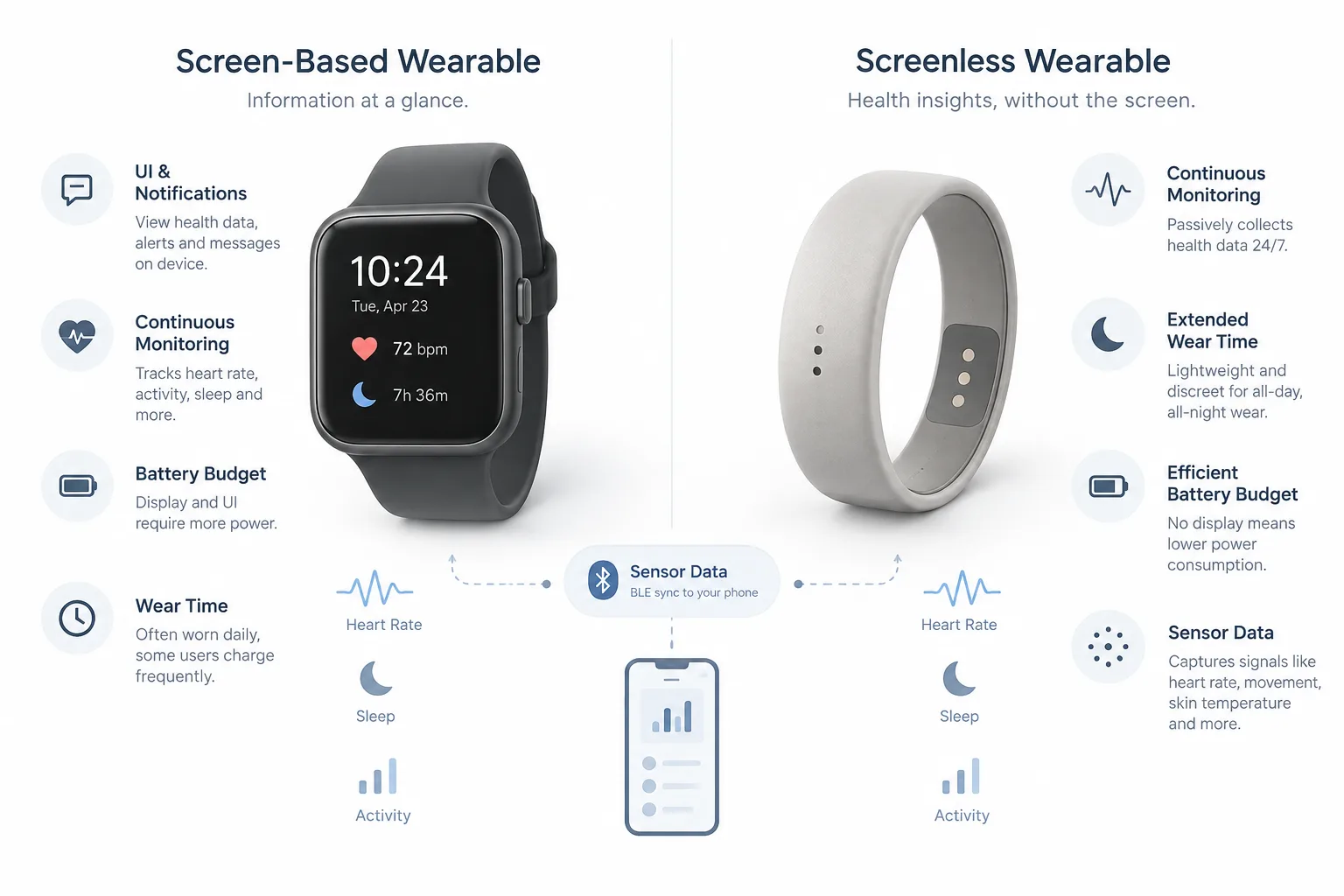
When defining a health wearable, one of the earliest questions is also one of the most consequential: does the product really need a screen?
It may look like a form-factor decision, but it affects battery size, mechanical design, sensor strategy, firmware behavior, BLE synchronization, and ultimately how many hours per day the user is willing to keep the device on.
There is no absolute winner between screened and screenless wearables. A display is valuable when the product needs on-device workouts, notifications, live metrics, maps or direct interaction. But when the primary goal is long-term monitoring of heart rate, HRV, sleep or activity, we care more about how much continuous, usable data the device can collect every day.
01 Screened and screenless wearables allocate limited resources differently
Every wearable has a limited power, space and compute budget. A screened product must support sensing as well as display, touch, UI and notification workloads. A screenless product can reduce those interface-related demands and place more of its budget around sensors, battery life, BLE, local storage and algorithms.
Screened health wearables: a better fit when live information and direct on-device interaction are central to the experience.
Screenless health wearables: a better fit when continuous sensing, long-term data collection and low-friction wear are the primary goals.
Removing a display does not make PPG inherently more accurate. What changes is how the product allocates its limited system resources.
02 The power budget becomes very different once you do the math
Assume a health wearable uses a 100 mAh battery. With a simple idealized calculation:
3 days ≈ 1.39 mA average | 7 days ≈ 0.60 mA | 14 days ≈ 0.30 mA
This ignores conversion losses, battery aging, temperature and usable-capacity limits. At a 14-day target, the theoretical whole-device average is only about 300 μA.
For comparison, a typical low-power BLE SoC can draw about 7.1 mA while transmitting at 1 Mbps and 0 dBm, and about 6.5 mA while receiving. Those radio-active currents are more than twenty times a 300 μA whole-device average budget.
That is why battery life is not determined by choosing a “low-power MCU” alone. The real question is how long sensors remain active, how often the MCU wakes, how long BLE connections stay open, how frequently flash is written, and how much additional system activity the display and UI introduce.
Source: Nordic Semiconductor — nRF52832 Power Management
03 For health products, wear time is part of the data quality problem
Health monitoring depends on time series. Sleep, resting heart rate, HRV and activity trends all lose context when the device is frequently removed or charging.
A roughly six-month wrist-wear study analyzed 296 participants across 44,003 monitored days. The study defined a valid monitoring day as at least 22 hours of wear and reported a median long-term adherence of 88.2%. The population was a specific medical research cohort, so the number should not be treated as a general consumer benchmark. But it illustrates a useful engineering point: for long-term monitoring, hours of usable data per day matter.
296 participants | 44,003 monitored days | ≥22 h/day valid-day threshold | 88.2% median adherence
This is where a screenless approach becomes interesting. The goal is not necessarily to make the user interact with the device more often, but to make the device easier to forget—through lower interaction overhead, longer intervals between charges and more natural continuous wear.
Source: European Heart Journal – Digital Health, 2024 (PMID 39318686)
04 The saved budget only matters if it goes back into sensing and data quality
A screenless design is not valuable simply because it can reduce BOM cost. The more meaningful opportunity is to redirect system budget toward sensing.
For PPG, continuous heart-rate applications commonly operate in the 25–100 Hz range. Some low-power PPG AFEs can achieve receiver current around 12 μA at 25 Hz.
25 Hz, one 16-bit PPG channel ≈ 4.32 MB/day of raw samples
25 Hz, 3-axis accelerometer, 16-bit/axis ≈ 12.96 MB/day of raw samples
A real product will not simply store every raw sample forever, but the calculation makes the point: “continuous monitoring” is really a scheduling problem across sampling, processing, storage, synchronization and power.
Mechanical design is just as important. Public wrist-PPG optomechanical guidance recommends keeping the air gap between the optical components and the transparent window to roughly 0.8 mm or less, with window transmittance above 90% in the operating wavelength range. A larger gap can increase internal optical crosstalk and reduce useful returned signal.
PPG reference: Air gap ≤ ~0.8 mm | Window transmittance >90%
So the real question is not whether the product has a screen. It is whether the available space and system budget are being used where they improve skin contact, optics, sensing, power behavior and the data path.
Source: Texas Instruments — AFE4432 continuous heart-rate application
Source: Analog Devices — Optomechanical Integration Guidelines for Wrist PPG
05 The right choice depends on what the product is trying to solve
If users need live workout metrics, maps, notifications, shortcuts or other direct interactions on the device, the display is part of the product value.
If the core proposition is closer to 24/7 health monitoring, the questions change: how many hours of valid data can be collected each day? How many days can the product run between charges? Will users remove it at night? How should PPG behave at rest versus during movement? What happens when the phone is unavailable? How is historical data recovered after BLE reconnects?
That is why we do not view a screenless health wearable as “a smartwatch with the display removed.” It is a different system trade-off.
Less UI does not automatically mean better measurement accuracy. But if less interaction enables longer wear time, a more realistic power budget and fewer gaps in the data timeline, it can create a stronger foundation for long-term health analysis.
Hulin Technology
Hulin Technology supports screenless health wearable development across product definition, sensor selection, PCBA and optomechanical integration, low-power firmware, BLE and device SDKs, health algorithms, mobile applications and AI-based data experiences.
For this category, our focus is not simply removing a display. We work around wearability, continuous sensing, power budget, signal quality and software experience as one system, helping customers move from product definition and feasibility validation toward complete-device development and mass production.
Contact Us:
Email: allen.yue@szhulin.com
Phone: +86 13510104324
WeChat Official Account: Hulin Technology